

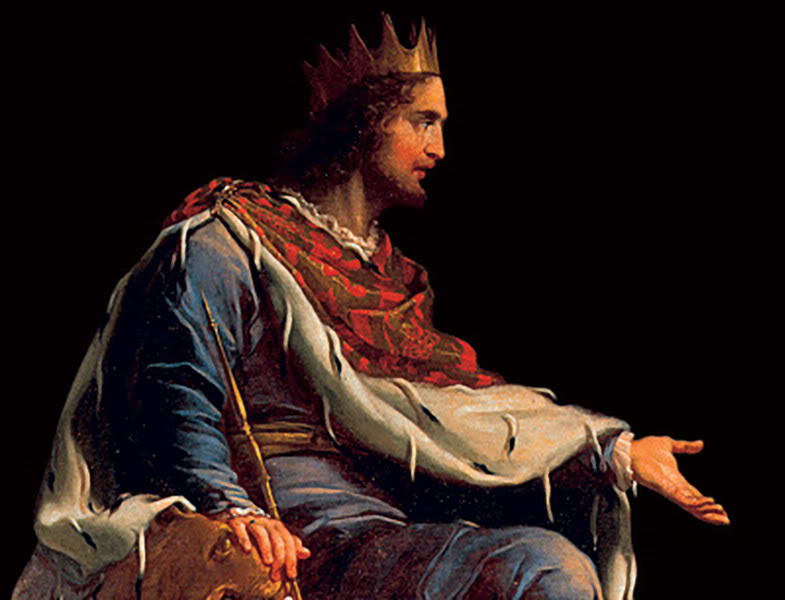
A few rumbles occur along the way in Solomon’s story which betray a storm brewing. First, we read about Solomon’s gorgeous plan for the Temple—God’s dwelling. Yet, the Bible makes a subtle note: Solomon builds himself a larger house than he builds for God (cf. 1Kings 7: and 1Kings 6).
Secondly, Solomon begins to marry foreign wives, especially from lands that should cause alarm for the attentive reader, like Pharoah’s daughter! Hasn’t Egypt caused Israel enough trouble?
Finally, Solomon disobeys a direct admonition found in the Torah to not multiply horses, wives, and gold (Deuteronomy 17:16-17) by doing those three things exactly! (1Kings 10:14-29).
1Kings 11 confirms for the reader Solomon has fallen away from God: “For when Solomon was old, his wives turned his heart away after other gods; and his heart was not wholly devoted to the Lord his God, as the heart of David his father had been. For Solomon went after Ashtoreth the goddess of the Sidonians and after Milcom the detestable idol of the Ammonites.” (1Kings 11:4-5).
The Consequences: “I will surely tear the kingdom from you, and will give it to your servant. 12 Nevertheless I will not do it in your days for the sake of your father David, but I will tear it out of the hand of your son” (1Kings 11:11-12). The rest of the story of the Old Testament and a major theme of the New Testament is what is going to happen to this broken kingdom.
From the Catechism of the Catholic Church
The tenth commandment unfolds and completes the ninth, which is concerned with concupiscence of the flesh. It forbids coveting the goods of another, as the root of theft, robbery, and fraud, which the seventh commandment forbids. “Lust of the eyes” leads to the violence and injustice forbidden by the fifth commandment.319 Avarice, like fornication, originates in the idolatry prohibited by the first three prescriptions of the Law.320 The tenth commandment concerns the intentions of the heart; with the ninth, it summarizes all the precepts of the Law.
CCC, 2534

The Temple becomes a major figure in the Old Testament from this point on. It will continue to play a role even into the New Testament both in Jesus’ ministry, in Paul’s letters and even in the book of Revelation. The construction of the Temple, worship at the Temple, the Old Testament destruction of the Temple, and its reconstruction mark the plot lines of the rest of the Old Testament. It was built by David’s son, Solomon.
Solomon’s plan and construction of the Temple reflected something about his understanding of the role the Temple played. He had it constructed in seven years (1Kings 6:38), and he made sure the design of the Temple resembled the Garden of Eden (such garden imagery and the rivers coming from it in 1Kings 1:33 matches Genesis 2:13). For Solomon, the Temple is a miniature version of the cosmos. And the purpose of the cosmos is worship and communion with God. The Garden of Eden was originally a sanctuary where man communed with God. At the center of the Temple was the sanctuary which housed the Ark of the Covenant, where the high priest would pray to God face to face. Interestingly, it was also built on Mt. Moriah, the same place where Abraham took Isaac to be sacrificed (2Chronicles 3:1) representing the understanding of Abraham’s act of perfect worship.
Solomon spared no expense either for its construction or its dedication sacrificing so many animals they were too great to be counted. Yet, even Solomon with his wisdom and the magnificent construction of the Temple would soon fall into false worship irreparable harming the kingdom and ultimately the security of the Temple he had built.
From the Catechism of the Catholic Church
For the People of God, the Temple was to be the place of their education in prayer: pilgrimages, feasts and sacrifices, the evening offering, the incense, and the bread of the Presence (“shewbread”) – all these signs of the holiness and glory of God Most High and Most Near were appeals to and ways of prayer. But ritualism often encouraged an excessively external worship. The people needed education in faith and conversion of heart; this was the mission of the prophets, both before and after the Exile.
CCC, 2594

King David loved the Lord and worshipped him well with an undivided heart. He recognized that it was time that what Moses taught should come to pass:
“When you cross the Jordan and live in the land which the LORD your God is giving you to inherit, and He gives you rest from all your enemies around you so that you live in security, 11 then it shall come about that the place in which the LORD your God will choose for His name to dwell, there you shall bring all that I command you: your burnt offerings and your sacrifices, your tithes and the contribution of your hand, and all your choice votive offerings which you will vow to the LORD.”
Deuteronomy 12:10-11
We read in 2Samuel 7:1-3
“Now when the king dwelt in his house, and the LORD had given him rest from all his enemies round about, the king said to Nathan the prophet, “See now, I dwell in a house of cedar, but the ark of God dwells in a tent.” And Nathan said to the king, “Go, do all that is in your heart; for the LORD is with you.”
2Samuel 7:1-3
David desired to build God a house, a place for worship, a place for “His name to dwell.” God responds to David:
“The Lord declares to you that the Lord himself will establish a house for you:12 When your days are over and you rest with your ancestors, I will raise up your offspring to succeed you, your own flesh and blood, and I will establish his kingdom. 13 He is the one who will build a house for my Name, and I will establish the throne of his kingdom forever. “
2 Samuel 7:11-13
The immediate fulfillment of this is Solomon, David’s Son who succeeds him and builds a Temple. Yet, with the full revelation of Christ, the “son” who will build the true Temple and establish God’s kingdom forever is Jesus, the perfect fulfillment of God’s plan. He is the true temple, who bears the Name of God, who reigns on the throne of God forever, and actually dwells among men. Solomon and the physical temple are the prefigurement of what Jesus will perfect.
Jesus is the son of David who will fulfill not only the kingly role of his forefather David, but also the priestly role David played, the one who offers God perfect worship, and the one who not a man after God’s own heart, but is a man with God’s own heart.
From the Catechism of the Catholic Church:
The Temple of Jerusalem, the house of prayer that David wanted to build, will be the work of his son, Solomon. The prayer at the dedication of the Temple relies on God’s promise and covenant, on the active presence of his name among his People, recalling his mighty deeds at the Exodus. The king lifts his hands toward heaven and begs the Lord, on his own behalf, on behalf of the entire people, and of the generations yet to come, for the forgiveness of their sins and for their daily needs, so that the nations may know that He is the only God and that the heart of his people may belong wholly and entirely to him.
CCC, 2580

The Psalms were composed by many different people, spanning over a long period of time, for a many different occasions. Most of the Psalms are attributed to David, but more were added to the Psalter long after his death.
The Psalms are described as the “masterwork of prayer” in the Catechism of the Catholic Church.They embody the perfect expression of worship: abiding with God in his sanctuary, committed love for God, communal worship, and moral uprightness. In the Psalms, God is praised and adored liturgically but in a way that is not empty or mechanical. The authors of the Psalms are personally invested in their prayers expressing authentic hope and conversion of heart.
The Psalms are woven in and out of our worship as Catholics today. The Liturgy of the Hours is the continual recitation of the Psalms throughout the day. We pray the Psalms during each and every Mass. They are the book the New Testament quotes the most.
The Psalms articulate the various modes and seasons of mankind in his relationship with God. Ranging from rejoicing in God’s triumphant victory, to trustfully lamenting when we enduring a major trial. The Psalsm encompass the whole of the life of man—which is exactly what worship should do.
From the Catechism of the Catholic Church
The Psalms constitute the masterwork of prayer in the Old Testament. They present two inseparable qualities: the personal, and the communal. They extend to all dimensions of history, recalling God’s promises already fulfilled and looking for the coming of the Messiah.
CCC, 2596

Saul was not an ideal king, but he is the king Israel deserved. God, in his kindness, raised up a king better than what they deserved. He raised up a king “after God’s own heart” (Acts 13:22). This king is named David.
Sadly, most people might know two stories about David: his defeat of Goliath and his incident with Bathsheba. Certainly, the latter does not paint David in a very flattering light. Yet, according to the writings of the rabbis, David was said to be the standard of virtue in the Old Testament (*except for the incident with Bathsheba it was always noted!). Interestingly, even his sin reveals a good deal about his love for God and his humility. David is the first person to say “I’m sorry” for his sin up to this point in the Bible. Adam and Eve didn’t do it, the Cain didn’t do it, no one else prior to David admitted their fault openly and repented!
Above all, David worshipped God alone. David’s heart belonged completely to God and made worship of him the center of his life. His way of worship was lively and passionate. He danced before the Lord and offered abundant sacrifices expressing his effusive love for God. He wrote many of the Psalms which are used for worship to this very day!
David is a champion of right worship of God—worship that not only compasses liturgical norms, but worship that involves the whole self, and most importantly the heart.
From the Catechism of the Catholic ChurchDavid is par excellence the king “after God’s own heart,” the shepherd who prays for his people and prays in their name. His submission to the will of God, his praise, and his repentance, will be a model for the prayer of the people. His prayer, the prayer of God’s Anointed, is a faithful adherence to the divine promise and expresses a loving and joyful trust in God, the only King and Lord. In the Psalms David, inspired by the Holy Spirit, is the first prophet of Jewish and Christian prayer. The prayer of Christ, the true Messiah and Son of David, will reveal and fulfill the meaning of this prayer. CCC, 2579

Israel mistakenly attributed the success of the other nations to them having a king, rather than God’s discipline. For Israel, with their wandering hearts, many thought a king would permit them victory regardless of their behavior.
So they insisted that Samuel, a righteous judge, anoint Saul the king of Israel (1Samuel 8:1-5). Samuel saw right through their plan and urged them to recall that God was their king. God, noting their rejection of him, nevertheless permitted them to have a king. Saul was indeed a king like the other nations.He raised their taxes, he took from their land what he wanted, and called their sons away on military duty. Had worship and righteousness been their priority, they would have enjoyed God’s blessing and bounty. Asking to be like the other nations instead of being the light to the nationsas they were supposed to be continues to mark their long road towards right worship.
From the Catechism of the Catholic Church
Many religions invoke God as “Father”. The deity is often considered the “father of gods and of men”. In Israel, God is called “Father” inasmuch as he is Creator of the world. Even more, God is Father because of the covenant and the gift of the law to Israel, “his first-born son”. God is also called the Father of the king of Israel. Most especially he is “the Father of the poor”, of the orphaned and the widowed, who are under his loving protection.
CCC, 238

The first Book of Samuel gives us a close portrait of the righteous judge Samuel. He was a gift from God to Hannah who struggled to conceive. She pleaded to God and even promised to give Samuel to the service of the Lord should she conceive (1Samuel 1:9). This is reminiscent of Abraham’s willingness to give up Isaac because of his trust in God. The chapter which describes Samuel’s parents and God’s gift of a son to them mentions “worship” many times.
Samuel is a major figure for Israel and largely in that he leads the people in right worship. In one example of this, the Israelites were under a severe threat by the Philistines* (1Samuel 7). They put away their idols, confessed their sins to the Lord, and promised to serve him alone. Samuel made constant intercession and sacrifice to God and the Lord responded by a loud peal of thunder and lightning which frightened the Philistines so dramatically they turned and ran away. Israel pursued them and killed them.
The Philistines were defeated by God’s response to Samuel’s right worship and Israel’s conversion of heart. Once again, the Bible is teaching us that worship and right conduct show our trust in God and our dependence on him. He confirms our trust is rightly placed in him by winning the victory for them.
From the Catechism of the Catholic Church
The prayer of the People of God flourishes in the shadow of God’s dwelling place, first the ark of the covenant and later the Temple. At first the leaders of the people – the shepherds and the prophets – teach them to pray. The infant Samuel must have learned from his mother Hannah how “to stand before the LORD” and from the priest Eli how to listen to his word: “Speak, LORD, for your servant is listening.” Later, he will also know the cost and consequence of intercession: “Moreover, as for me, far be it from me that I should sin against the LORD by ceasing to pray for you; and I will instruct you in the good and the right way.”
CCC, 2578
*For the sake of brevity, I am skipping over the comical scene of the Philistines stealing the Ark of the Covenant and then bringing it into their pagan temple. They were cursed and did everything in their power to get it out of their land. Give it a read in 1Samuel 6!

After Joshua’s death, there is no strong leader of Israel. Each tribe governed itself under their own judge or judges. The cycle of the judges is as follows: the Israelites worshipped the false gods of the pagans, fell into idolatry, and suffered at the hands of their enemies. They would lose their battles. They would cry out to God who would deliver them. They would experience a period of peace and righteousness under a just judge. Complacency (and it seems amnesia!) would set in and they would fall into idolatry. Wash. Rinse. Repeat.
We should worship God out of justice and gratitude for all he has done for us. Unfortunately, spiritual immaturity was so rampant among the Israelites that right worship was often not given to God out of justice, gratitude, or love, but out of self-interest. If they were faithful, they would prosper. If they were not, they would fail.
“Health and wealth” as a motive for worshipping God is disordered and dangerous. A quid pro quorelationship with God where we worship God whenever we feel he can be useful to us is gross utilitarianism. However, sometimes God accommodates himself to meet us in our most immature states of spiritual development to draw us into perfect worship, when we worship him for his own sake in good times and bad. Does our worship of God mirror the times of the judges or is it steadfast whether the Lord gives or takes away?
From the Catechism of the Catholic Church
The practice of the moral life animated by charity gives to the Christian the spiritual freedom of the children of God. He no longer stands before God as a slave, in servile fear, or as a mercenary looking for wages, but as a son responding to the love of him who “first loved us”:
CCC, 1828
If we turn away from evil out of fear of punishment, we are in the position of slaves. If we pursue the enticement of wages, . . . we resemble mercenaries. Finally if we obey for the sake of the good itself and out of love for him who commands . . . we are in the position of children.
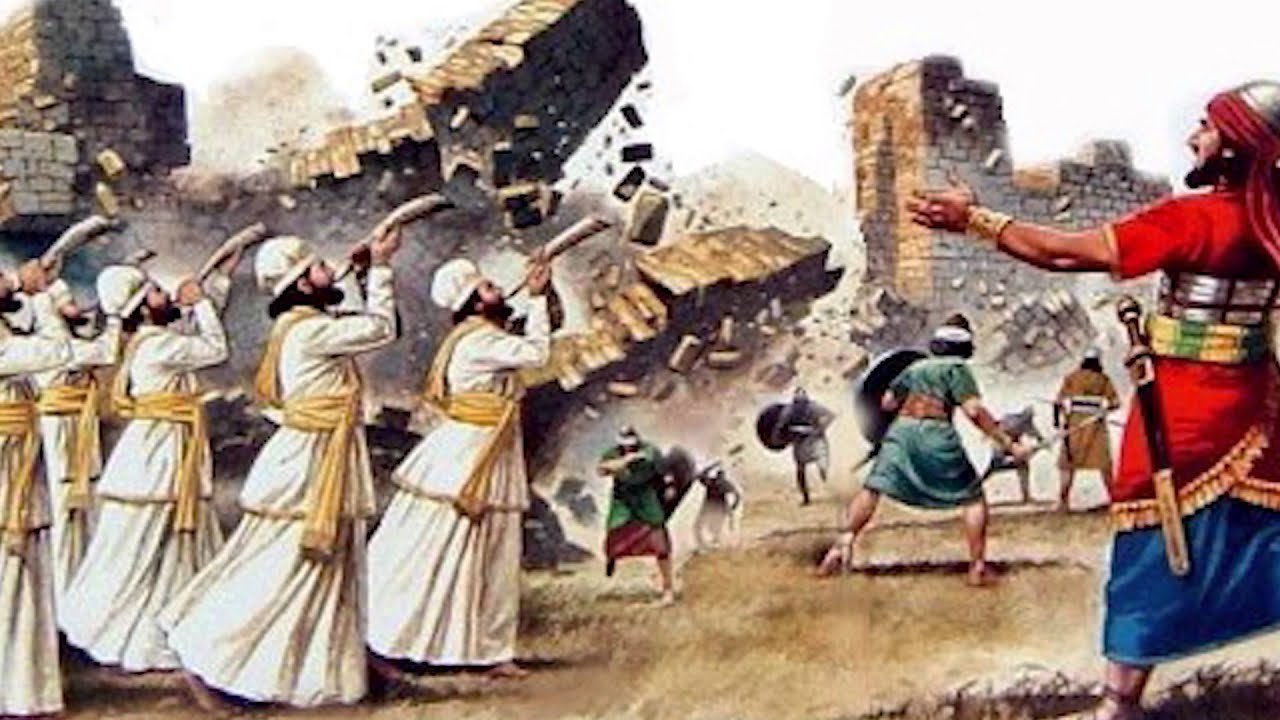
Just how powerful is proper worship? It is strong enough to move mountains, or in this case, highly fortified walls!
We read in Joshua 6:1-27, the Israelites, after forty years of wandering in the desert, finally made it to the Promised Land, but there encountered others who have encroached upon this beautiful place. We have learned already that Israel tends to have the habit of imitating the cultures in which it finds itself, adopting their pagan gods and practices. So God instructrs the Israelites, for the well-being of their spiritual life—and the salvation of the world which was to blessed by Israel—that Israel had to forecefully drive out, and in some cases put to death, the foreign inhabitants of their land. This was done so Israel would not be tempted to fall into false worship.
One such stronghold that needed to be conquered was Jericho, a city fortified by seemingly impenetrable walls. God gave Joshua (the leader after Moses) instructions not to launch a military assault, but instructions for worship. Joshua was to lead Israel in a procession around the city, following the Ark of the Covenant, offering sacrifices and praise to the Lord.
After their procession, they are to shout, blow their trumpets, and God himself would cause the walls to come a-tumbling down.
What lesson can we learn from this? That prayer and worship is more powerful than military strength. Their trust in God and God’s deliverance of them comes from a liturgical act.
Do you know someone who seems to have impenetrable defenses against the Gospel? Pray. Pray for them instead of arguing! Encircle situations with prayer and worship of God and rely on him to break down their defenses.
From the Catechism of the Catholic Church
Such a battle and such a victory become possible only through prayer. It is by his prayer that Jesus vanquishes the tempter, both at the outset of his public mission and in the ultimate struggle of his agony. In this petition to our heavenly Father, Christ unites us to his battle and his agony. He urges us to vigilance of the heart in communion with his own.
CCC, 2849
 Catholic Bible Bee